Cannabis seeds













 Alchimia now available in the USA!
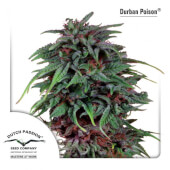
Information on Durban Poison Regular
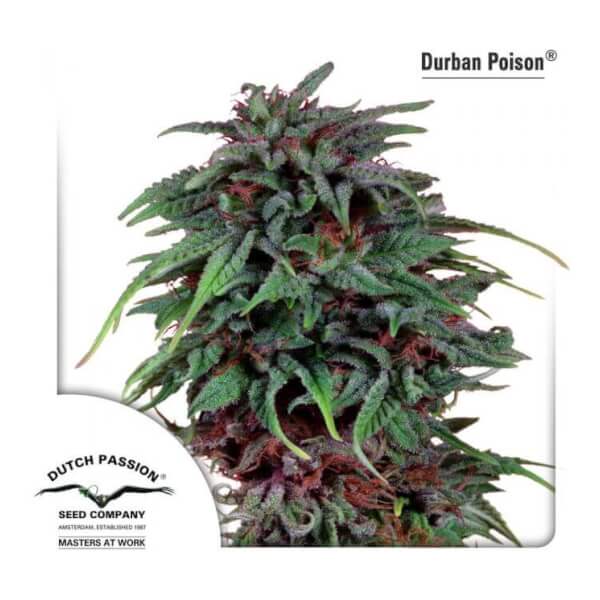
Durban Poison Regular by Dutch Passion brings the famous South African sativa to the garden in its regular seed format, so every pack gives you both male and female plants to work with. This sativa-dominant line carries a spicy, hazy aroma of aniseed, licorice, lemon and clove, THC levels that range from the mid-teens to around 25% depending on the source, and a clear, energizing effect that keeps the mind active for hours.
The story behind Durban Poison
Durban Poison takes its name from the port city of Durban, South Africa, where it developed over generations as a landrace sativa shaped by the local climate. Seeds reached Europe and the United States in the 1970s, and the Dutch line was inbred for many years until it became a stable, outdoor-hardy plant able to handle the wind and rain of Northern Europe.
One of the best-known tales credits cannabis writer Ed Rosenthal with bringing Durban to the US. During a 1970s trip to Amsterdam he visited the Transvaal coffee shop, run by South Africans who imported herb from home, and found seeds in the bag of Durban he bought. He took them back to California, worked on them with his writing partner Mel Frank, and seeds later reached Skunkman Sam, who spent several growing cycles breeding out the intersex tendency of the original landrace before taking the improved Durban to Amsterdam in the mid-1980s.
The strain's influence reaches far beyond its own garden. Durban genetics sit at the base of Girl Scout Cookies, the cross with OG Kush that later led to Sherbet and Gelato, and Dutch Passion's own entry placed seventh in the outdoor category at the 2016 Emerald Cup.
The name has traveled outside the cannabis world too. A 2013 South African feature film borrowed the strain's name for its title, and several songs have been named after it.
Genetics and plant structure
Durban Poison is a sativa-dominant strain built almost entirely on the Durban landrace, with only a light indica touch that the breeder has never identified. The result is a plant that behaves like a classic African sativa in bloom yet finishes much sooner than many of its equatorial relatives, in about 8 to 9 weeks.
Seedlings often surprise growers with broad, indica-style leaves during early growth, before the sativa side takes over with long colas and small leaves. Sturdy stems and strong side branches carry the weight of large, resin-covered buds that are noticeably dense for a sativa, with a very good bud-to-leaf ratio at harvest.
Because this is a regular seed, the pack will produce both male and female plants. That makes it a smart choice for growers who want to select a mother plant from several phenotypes, ranging from tall, stretchy types to shorter and more compact ones, and the breeder also points out that Durban works well as a partner for late-flowering strains in breeding projects.
Durban
This South African landrace evolved over generations around the city that gave it its name. In its original form it ripened quickly but showed intersex traits, something common among landraces, and breeders worked them out over many generations of selection and inbreeding.
Dutch Passion's version is the product of that long inbreeding work, carried out through the 1970s and adapted to the cool, wet conditions of Northern Europe. It keeps the uplifting character and the anise-licorice signature that made the Durban name famous.
Growing Durban Poison
Indoors, Durban Poison flowers in about 8 to 9 weeks under 12/12 and can return 450 to 650 g/m² (roughly 1.5 to 2.1 oz per square foot) in a well-run room. Expect a strong stretch once flowering starts, with plants commonly doubling or even tripling in height, so plan your vegetative period and ceiling space with that in mind.
Training pays off with this strain. Topping, FIMing, LST and supercropping help keep the canopy even, and a SCROG net is a natural fit for spreading the colas under the light. Give her generous root space, since she appreciates a large container and responds with more vigorous growth.
Outdoors, Durban Poison can grow into a big plant, reaching 2 to 4 meters (about 6.5 to 13 feet) depending on the season and the phenotype. Harvest in the Northern Hemisphere usually falls between late September and mid-October, and yields of around 450 to 550 g per plant (about 1 to 1.2 lb) are reported, with some growers going well beyond that.
The strain is known for being tough and vigorous, hardy enough for cooler northern latitudes and tolerant of wind and rain. It also has a reputation for mold and pest resistance, although its dense buds still call for good airflow in very humid weather. Overall it is manageable for beginners who are willing to train it, while experienced growers will enjoy sorting through the phenotypes.
Flavor and effect
The aroma of Durban Poison is spicy and hazy, layered and hard to pin down, neither sour nor typically sweet. On the palate it brings aniseed and licorice with a candy-like sweetness, plus touches of lemon and clove, while some phenotypes lean toward more herbal tones.
Lab tests of Durban Poison flowers have pointed to terpinolene as a leading terpene, together with ocimene and myrcene, a mix that fits its fresh, herbal and slightly floral character. Terpene results vary with growing conditions and testing methods, so each plant may lean in a slightly different direction.
The effect is a classic sativa high: clear, uplifting and energizing, with a cerebral push that suits creative or productive daytime activities. It is often compared to Thai sativas and is notably long-lasting, and larger amounts can turn more intensely cerebral, so many people save it for the day rather than the evening.
Specifications on Durban Poison Regular
| Regular Seeds | |
| Seed bank | Dutch Passion |
| THC Content | Medium (1-15%) |
| Indica/Sativa Genotype | Sativa +90% |
| Flavor | Sweet, Skunk |
| Effect | Stimulating |
| Outdoor harvest | Standard (Autumn) |
| Indoor flowering | Fast (-9 weeks) |
| Indoor yield | Medium (350-500 g/m2) |
| Outdoor yield | High (400-1000 g/plant) |
| Genetics | Durban Poison |
Questions and answers
Durban Poison Regular related products (Dutch Passion)