Cannabis seeds













 Alchimia now available in the USA!
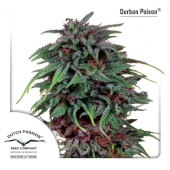
Information on Durban Poison
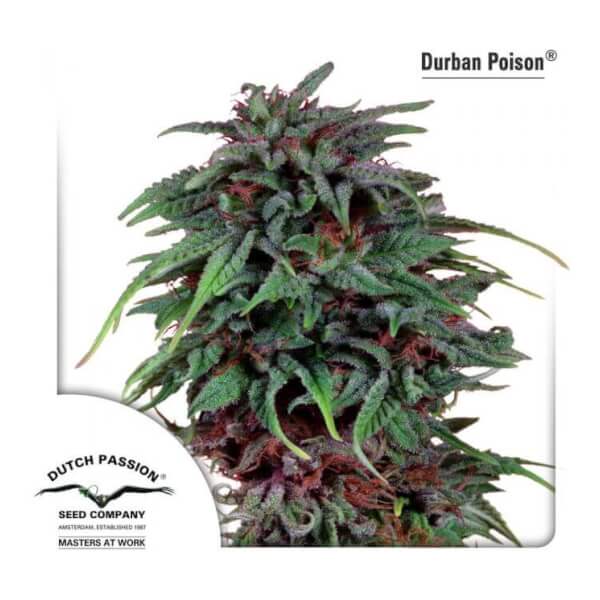
Durban Poison by Dutch Passion is a feminized photoperiod strain with a sativa genotype above 90%, built around the South African Durban https://www.alchimiaweb.us/landrace-tag-37/ line. Its aroma leans sweet and spicy, with the aniseed and liquorice notes that made this plant famous, rounded off by lemon and clove nuances. The THC level sits in the medium range and the effect is clearly stimulating, closer to clarity and movement than to heaviness.
History of Durban Poison
Dutch Passion sources this line from South Africa, from the coastal area around the city of Durban, and brought it to Holland where it was inbred over many years during the 1970s. With each generation the plants became better adapted to the windy, rainy conditions of northern Europe, which is why the strain still performs in latitudes far from its origin.
It is one of the oldest catalogue entries still offered by the bank, available in both regular and feminized form, and it has been kept rather than reinvented. Several retailers describe it as a cornerstone strain of the modern market, cited as part of the heritage behind the GSC line and its descendants such as Sherbet and Gelato.
Growers on old-school forums such as ICMag have argued for years about how close any commercial Durban is to the plants smoked in the 1980s, and reports range from "it really felt like a landrace" to complaints about broad leaves in veg. The honest reading is that this is a Dutch-bred, long-inbred Durban line rather than a fresh landrace collection.
Genetics and plant structure
The product sheet lists a sativa genotype above 90%, and Dutch Passion presents the strain as a pure landrace sativa line from South Africa. Part of the distributor network records the lineage as Durban crossed at some point with an unknown indica introduced during the Dutch breeding work.
That mixed history shows up in the growth pattern. Plants often start with wide indica-style leaves during early growth, and then the sativa side takes over in the second half of bloom, producing long flowers pierced by slim, narrow leaflets.
The frame is slim and vertical, with generous internodal spacing and strong side branches that hold long, heavy, resinous flowers without snapping. Stems are described as tough and easy to manipulate, and the calyx-to-leaf ratio is high, with even the small sugar leaves loaded with resin.
Durban, the South African landrace
The Durban side comes from the port city of the same name on the east coast of South Africa, a region with a long history of outdoor sativa cultivation. Landrace populations of this kind were selected by climate rather than by breeders, which is usually credited for the sturdy, self-sufficient behaviour this plant still shows.
Dutch Passion describes the material as imported from South Africa and then produced in Holland, exclusively inbred and, in their original catalogue wording, never hybridized. The anise scent is the trait most often used to identify the line, and it appears again and again in independent grow reports.
Unknown indica
Several retailers reproducing the breeder text explain that, after a few generations in northern Europe, indica genetics from an unknown source found their way into the population. The practical consequence is a shorter, more reliable flowering time than a tropical sativa would normally offer.
Nobody publishes the identity of that indica, so it should be read as part of the strain's Dutch history rather than as a defined parent. What it contributes in the garden is density and speed rather than a change of character.
Growing Durban Poison
Indoors, flowering is fast for a sativa: the shop sheet classes it under nine weeks, and the breeder and most distributors quote 8 to 9 weeks. Counting a normal vegetative phase, one retailer estimates around 11 to 13 weeks from sowing to harvest.
Indoor yield is listed as medium, 350 to 500 g/m2, which is realistic for a plant that stretches hard rather than building a single fat central cola. Expect significant stretch at the start of bloom; one Dutch Passion grow report measured roughly 150% stretch over a 63 to 65 day cycle.
Outdoors the picture changes. Plants can reach 2 to 3 metres with enough root space, yields are listed as high at 400 to 1000 g per plant, and harvest falls in autumn, with the breeder pointing to the start of autumn and other sources to late September or early October.
Resistance is one of its strongest selling points. Buds are often dark green and described as resistant to mould and pests, and it is presented as tough enough for outdoor growing in extreme northern or southern latitudes, which explains its long career in cold, damp European gardens.
Difficulty is rated between easy and moderate depending on the source: Dutch Passion calls the genetics tough and easy to grow, while Zamnesia and Cannaconnection place it at moderate or medium. The main thing to manage is height, so plan the stretch and consider leaf tucking in early bloom to expose the flowers underneath.
Flavour and effect
The flavour listed on the sheet is sweet, and the breeder describes a spicy, hazy taste with hints of aniseed, liquorice, lemon and cloves. Grow reports confirm that the aniseed note is the one that fills the room, often backed by spicy herbal tones as the plants finish.
On the terpene side, independent profiles point to terpinolene as the dominant compound, supported by myrcene and pinene. That combination explains the sweet, citrus-tinged top note, the earthy base and the fresh pine edge that appear in the smoke.
The effect is listed as stimulating, and both the breeder and user-facing databases describe it as energising, uplifting and long-lasting, with reports of focus and creativity. The classic catalogue comparison is an "up" high similar to Thai strains, which is the kind of daytime, active character growers look for in a sativa of this type.
Visually, the finish adds to the appeal: plants frequently show purple and red tones as temperatures drop, with a dark autumn fade on the leaves and frosty, long flowers. Between that look, the aniseed nose and the short sativa bloom, Durban Poison remains an easy recommendation for anyone who wants an old-school plant without a three-month flowering period.
Specifications on Durban Poison
| Feminized Seeds | |
| Seed bank | Dutch Passion |
| THC Content | Medium (1-15%) |
| Indica/Sativa Genotype | Sativa +90% |
| Flavor | Sweet |
| Effect | Stimulating |
| Outdoor harvest | Standard (Autumn) |
| Indoor flowering | Fast (-9 weeks) |
| Indoor yield | Medium (350-500 g/m2) |
| Outdoor yield | High (400-1000 g/plant) |
| Genetics | Durban Poison |
Questions and answers
Durban Poison related products (Dutch Passion)