
 Cannabis seeds













 Alchimia now available in the USA!
A lineage between Humboldt and Spain
According to Project CBD, Northern California growers rediscovered whole-plant CBD in late 2009, when lab testing began to reveal unusual cannabinoid profiles. Those first cultivars, including Harlequin, Sour Tsunami, Jamaican Lion and Omrita Rx, came in at around 8 to 10 percent CBD with 5.5 to 7 percent THC.
Behind several of them was Lawrence Ringo, a Southern Humboldt farmer who founded the Southern Humboldt Seed Collective in 2010. Ringo had spent years hand-crossing low-THC plants with no idea that CBD would climb so high, and that work produced Sour Tsunami, Harle-Tsu, Canna-Tsu and Swiss Tsu.
His widow, Kat Hart, told High Times about the day analyst Samantha Miller called to report that Sour Tsunami had tested above 11 percent CBD while holding 6 to 7 percent THC. The whole team cheered, and Miller added that eight more of Ringo's cultivars were pointing in the same direction.
Around the same time in Spain, Resin Seeds introduced Cannatonic, regarded as one of the first CBD-dominant strains, with ratios ranging from 1:1 to 18:1. Phenotypes such as ACDC, which reaches 20:1, were selected from Cannatonic, and its breeder teamed up with Shantibaba of Mr. Nice Seeds to found CBD Crew and bring CBD into established breeding lines.
Spain produced another early reference during those same years. Reggae Seeds, a Catalan seed bank that began selling seeds in 2006, released Juanita la Lagrimosa, a sativa-leaning cultivar with a balanced 1:1 profile. Its breeder, Jimi, has named Reina Madre, also known as Queen Mother, and NYC Diesel as its parents, although an archived breeder description lists a Mexican/Afghan cross with Reina Madre, a pedigree discrepancy that has never been fully settled.
For years Juanita circulated mainly as a clone-only plant. Élite Seeds, which later developed its own version together with Reggae Seeds, reports that the original cutting tested at around 8.8 percent CBD and 6.7 percent THC. Its citrus aroma and dependable CBD expression soon made it a sought-after breeding parent.
Reggae Seeds itself crossed its favorite Juanita clone with Jack the Ripper to create Sra. Amparo, while Philosopher Seeds used a Juanita male across several lines to pass on its citrus flavor and CBD content. Its descendants include Spicy CBD, also sold as SuperJuani, a 1:1 hybrid at around 8 percent of each cannabinoid, and autoflowers such as Lemon Auto CBD and Cheesy Auto CBD.
Mainstream attention arrived in 2013, when CNN aired the documentary Weed and the story of Charlotte's Web, a cultivar from the Stanley brothers in Colorado, put CBD at the center of public debate. Its full pedigree has never been disclosed, although several sources link it to Harlequin and Sour Tsunami.
In the documentary, the plant went by a mocking nickname, Hippie's Disappointment, precisely because it lacked THC. According to people close to Ringo, the Stanleys had bought Harlequin and Sour Tsunami cuttings at his farm after a Cannabis Cup and spent nearly two hours listening to explanations about those plants.
As names multiplied, so did the confusion. Some CBD-dominant cultivars circulated under different names while actually being the same plant, something only terpene analysis could sort out.
Jeff Raber, president of the Los Angeles lab Werc Shop, explained that a terpene analysis works like a fingerprint. When his team compared Oracle and ACDC, two 20:1 cultivars sold separately, they concluded both were the same plant.
The genetics behind the ratio
The classic model, proposed by Etienne de Meijer and his team, explains the ratio through a single locus with two codominant alleles: BT, tied to THCA synthase, and BD, tied to CBDA synthase. BT/BT plants are Type I, BD/BD plants are Type III, and BT/BD heterozygotes are Type II.
This points to a pattern that is very useful for breeders. Crossing a Type I plant with a Type III plant yields an intermediate F1 generation, and selfing it produces an F2 that splits 1:2:1 across the three chemotypes.
More recent research adds nuance to this model, since the genes for both synthases appear in clusters of repeated copies whose number and expression also play a role. Even so, the THC to CBD ratio stays stable throughout the life cycle and holds up well against environmental changes, so it depends above all on the genetics of the seed.
Common profiles
1:1 strains
According to Dutch Passion, a 1:1 strain typically produces buds with around 6 to 8 percent THC and similar or slightly higher CBD levels, topping out near 10 percent for each cannabinoid. The result is a moderate effect that appeals to people looking for a gentler experience and to growers who want something different from high-potency cultivars. Juanita la Lagrimosa and the lines bred from it are a classic European example of this profile.
CBD-dominant strains
At the other end are Type III lines, with ratios of 20:1 or higher, that produce little to no high. ACDC is the classic reference, and some current autoflowers, such as Purplematic CBD from Royal Queen Seeds, are advertised at around 17 percent CBD with less than 0.5 percent THC.
Intermediate ratios
Between those two groups sit ratios such as 2:1 or 3:2, typical of the early Humboldt cultivars. Current examples listed by Leafly include CBD OG from Cali Connection and Panama Red F4 from Crickets and Cicadas, both at a 2:1 ratio.
Aroma and terpenes
CBD has no telltale smell of its own, so the aroma depends on the terpenes each line inherits. Leafly notes that the Sour Tsunami and Harlequin families test higher in limonene and pinene than Cannatonic-derived lines, giving them an aroma many growers prefer.
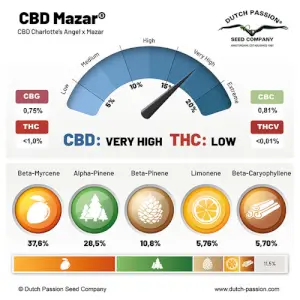
Charlotte's Web, by contrast, is described as having a quiet, earthy bouquet, with beta-caryophyllene, myrcene, alpha-pinene and humulene as its main terpenes. Project CBD also suggests that the differences users notice between cultivars with similar ratios may come down to their terpene profiles.
On the European side, Juanita la Lagrimosa is known for fruity, citrus notes that it tends to pass on to its offspring, one reason breeders have relied on it to add flavor to CBD crosses.
Growing CBD strains
These strains are grown like any other cultivar and are available as both feminized seeds and autoflowers. The difference lies in variability, since not every phenotype hits the advertised ratio and the seed bank's figure reflects an average across plants.
That is why many experienced growers turn to genetic testing on seedlings, which detects the THC and CBD alleles from a sample similar to the one used for sexing. Others prefer a leaf test around week six, which won't give final numbers but does offer a solid estimate of the ratio.
The genetic model also guides anyone who wants to make their own crosses. Two Type III parents can only pass on the BD allele, while crossing with a Type I plant brings back the THC allele and returns the F1 to an intermediate profile.
How to choose a CBD strain
The first criterion is the target ratio, a 1:1 for those who want to keep some effect or a CBD-dominant profile for those who would rather avoid it. After that, it pays to review the lab data published by the seed bank and the cultivar's genealogy.
Dutch Passion warns that some seeds sold as CBD by less scrupulous seed banks have shown low or zero levels of cannabidiol. A lineage traceable to Cannatonic, ACDC, Juanita la Lagrimosa or the Humboldt lines is a good starting point, although only final testing confirms the result.
In the United States, the 2018 Farm Bill allowed hemp breeders to develop genetics with up to 0.3 percent THC, which spurred a wave of new CBD-dominant lines. The federal definition of hemp is under revision and is moving to a total THC standard that includes THCA, so it is worth checking current regulations before choosing seeds.
CBD strains are no longer a lab curiosity but a category with history, well-understood genetics and profiles that differ widely from one another. Choosing well comes down to knowing which ratio you are after and relying on genetics with a documented track record.