
 Cannabis seeds













 Alchimia now available in the USA!








According to Shantibaba, the strain combines pollen from a Brazilian sativa male, which a family had preserved for decades on a small farm, with a female from Kerala, in southern India. After years of selecting and stabilizing those crosses, the result was White Widow.
During the 1980s, Scott Blakey traveled across Asia by motorcycle, collecting seeds and pollen in countries such as Burma, Thailand, Malaysia and India. It was at an ashram in Pondicherry that local sadhus gave him the name Shantibaba, which translates roughly as “person of peace.” In 1988 he settled in Amsterdam.
A story with two versions
White Widow's origin is still up for debate. Another version traces it to Ingemar of De Sjamaan, a low-profile Dutch grower who worked mainly outdoors. He doesn't disclose the exact genetics of his Widow and describes it as a mix of Brazilian and Indian sativas.
Ingemar has said in interviews that he found the seeds for the strain in a batch of charas, hand-rubbed hash. According to his account, he later gave the original plant to Arjan Roskam of Green House Seeds, along with permission to sell it under that name.
The story got more complicated in the late 1990s. Shantibaba left Green House Seeds and founded Mr. Nice Seedbank with Howard Marks. To set his original genetics apart from other seed banks' versions, he renamed many of his strains, and his White Widow came to be sold as Black Widow.
Why it's called White Widow
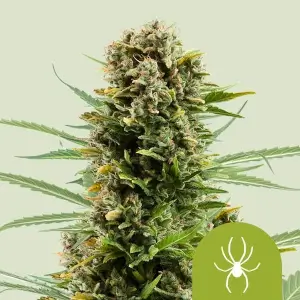
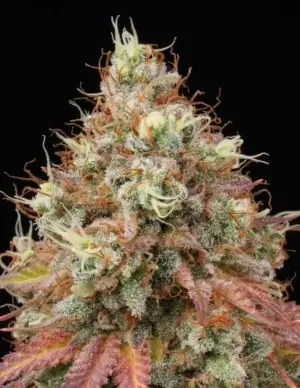
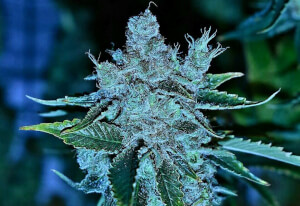
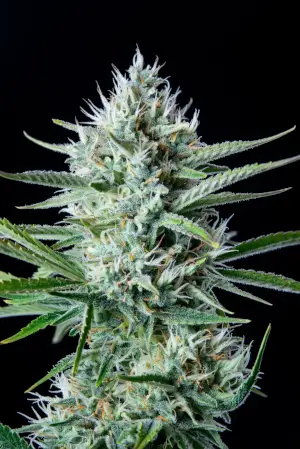
The name refers to how it looks. As harvest approaches, the buds become coated in a dense layer of trichomes that gives them a grayish-white sheen. That look, unusual at the time, was part of its appeal in competitions and in Amsterdam's coffeeshops.
Plant characteristics
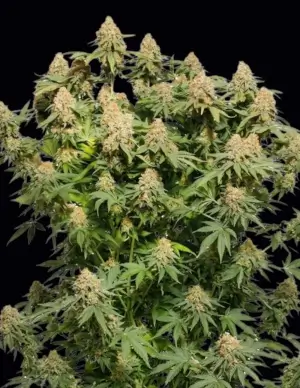
White Widow is a balanced hybrid selected with indoor growing in mind. The plants are compact, with moderate internode spacing, broad leaves with long tips and strong side branches that develop plenty of bud sites.
Indoors, it needs about 8 weeks of flowering. Outdoors in the Northern Hemisphere, it's usually ready in early October. Mr. Nice lists yields of 350 to 450 g/m² indoors (about 1.1 to 1.5 oz per square foot) and up to 400 g (about 14 oz) per plant outdoors.
Its aroma is strong, woody and earthy, with fresh pine notes and spicy hints reminiscent of incense. Its main terpenes include myrcene, caryophyllene and pinene. The original version sat around 15% THC, a modest figure next to today's hybrids, although many modern versions test higher.
It's a plant that handles stress and pests well and responds to a range of training techniques. That's why it's recommended for both beginners and experienced growers. Keep an eye on humidity late in flowering, when the buds put on weight.
A reference strain for hash
Its abundant resin made it a sought-after strain for extraction. When growers and hash makers began experimenting with dry sift and ice water extraction, White Widow became one of the go-to strains thanks to its dense trichome coverage.
That trait explains much of its role in breeding. Many breeders have used it to bring resin production and stability into their crosses, to the point that it has become a reference standard whenever the goal is a resinous plant.
The White family
White Widow is the root of the so-called White family, a group of strains that inherited its resin and structure. Among the best-known descendants are White Russian, which crosses it with AK-47, and White Rhino, which pairs it with an Afghan indica.
The family also includes Blue Widow and Blue Venom, crosses with Blueberry that lean fruitier, along with Great White Shark, White Domina and White Amnesia. White Castle combines White Widow with an Ice male, while Alaskan Ice crosses it with Haze. White Cheese, for its part, descends from White Rhino and a Skunk #1 phenotype with a cheesy aroma.
From Green House Seeds' White Widow alone, the SeedFinder database lists 37 direct descendants. Keep in mind that not every strain with “White” in its name belongs to the family: some just share the word and have a different origin.
White Widow in the US
Through the late 1990s and the 2000s, White Widow spread worldwide through clones and seeds. With legalization, many US markets kept stocking it because consumers already knew the name, and today it's often listed among the classic strains people ask for by name at dispensaries, alongside Blue Dream, Sour Diesel and OG Kush.
US breeders have also worked it into their programs. One example is White Dream, which crosses it with Blue Dream, the California classic. That way, the Amsterdam genetics live on in modern crosses made for the US market.
Who it makes sense for
Strains from the White Widow family suit growers looking for resinous plants that are easy to grow and finish relatively quickly. They also appeal to people making homemade extracts or looking for a proven genetic base for their own crosses.
Choosing between the original White Widow and its descendants depends on the profile you want. Versions with AK-47 or Afghan genetics tend toward a more classic character, while crosses with Blueberry or Blue Dream bring fruitier notes without losing the resin coat that gave the family its name.